Thursday, February 13, 2014

Maui - our best vacation ever!


Lahaina Welcome Sign


Maui….the ultimate Anniversary Vacation!


Amy and I went to Maui in late January to celebrate our 27th wedding anniversary!  This was a surprise Christmas gift I gave to Amy.  She has been wanting to go to Hawaii since our 20th Anniversary and we were finally in a place to take the trip.


Flight Out
So on Tuesday, January 28th, Amy and I got on a noon flight to Maui.  The flight is eight hours, and there is a four hour time difference between Maui and Dallas.  We arrived just after 4 pm local time to a wet and rainy afternoon.  We got our luggage and our jeep rental, and we were off to the Westin Resort just outside of Lahaina on the west side of the island.


Wind Mills along the mountain


The drive is a beautiful scenic trip along Highway 30.  It is a slow drive with the ocean on your left and the mountains on your right.  I was surprised to see all wind generators along one of the mountains, I did not think they would want to change the view like that! 


As we got closer to our hotel, you could see the signs of civilization as we got into Lahaina.  It is a six red light town!  The resort was nestled among seven or eight other resorts, with a beautiful golf course shared in the middle.


The resort entryway is beautiful - with a waterfall, a pond full of fish and a few flamingos.  Our recently renovated room was cozy and had a view of the pond and palm trees.  We could sneak a peak of the ocean, but our room was a bit too low to see a full ocean view.  We took a short walk along the seashore and grabbed a quick bite at the local shopping center and called it a night.


Flamingo's in the Hotel Pond
Pool Area

View from our room


Wednesday began with a wonderful breakfast at the hotel.  They had a huge spread at the buffet.  Amy had the traditional eggs, bacon and pancakes, and I fell in love with all the local fruit!  I discovered papayas and I was in love!  I do not think I have ever had them before.  I must have eaten a pound of them! 


After breakfast we headed to downtown Lahaina where we had reservations for a whale-watching tour with Pacific Whale Foundation!  The docks are right behind the famous Banyan tree. 


This is a very old tree that spreads itself across the entire park.  


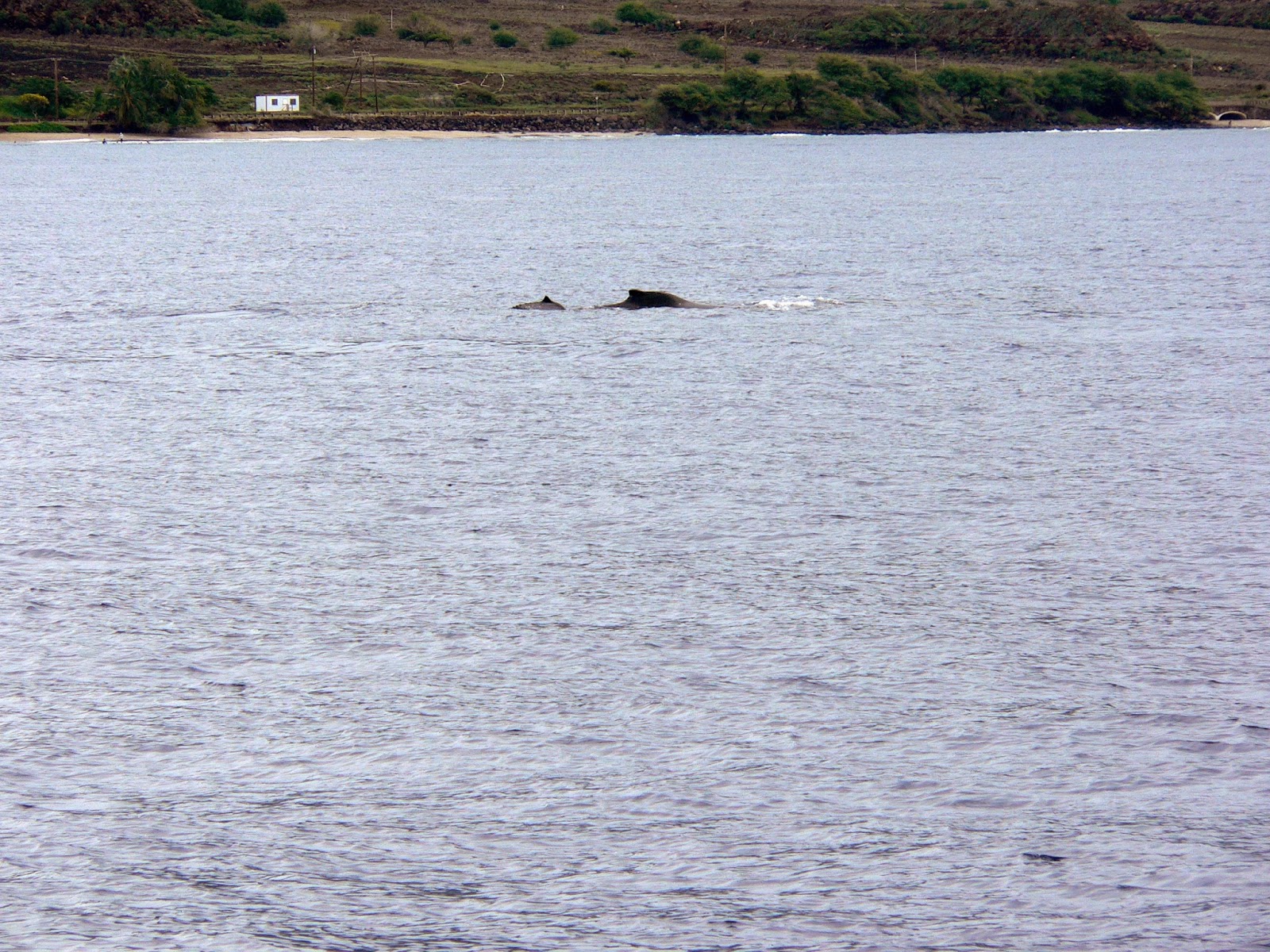
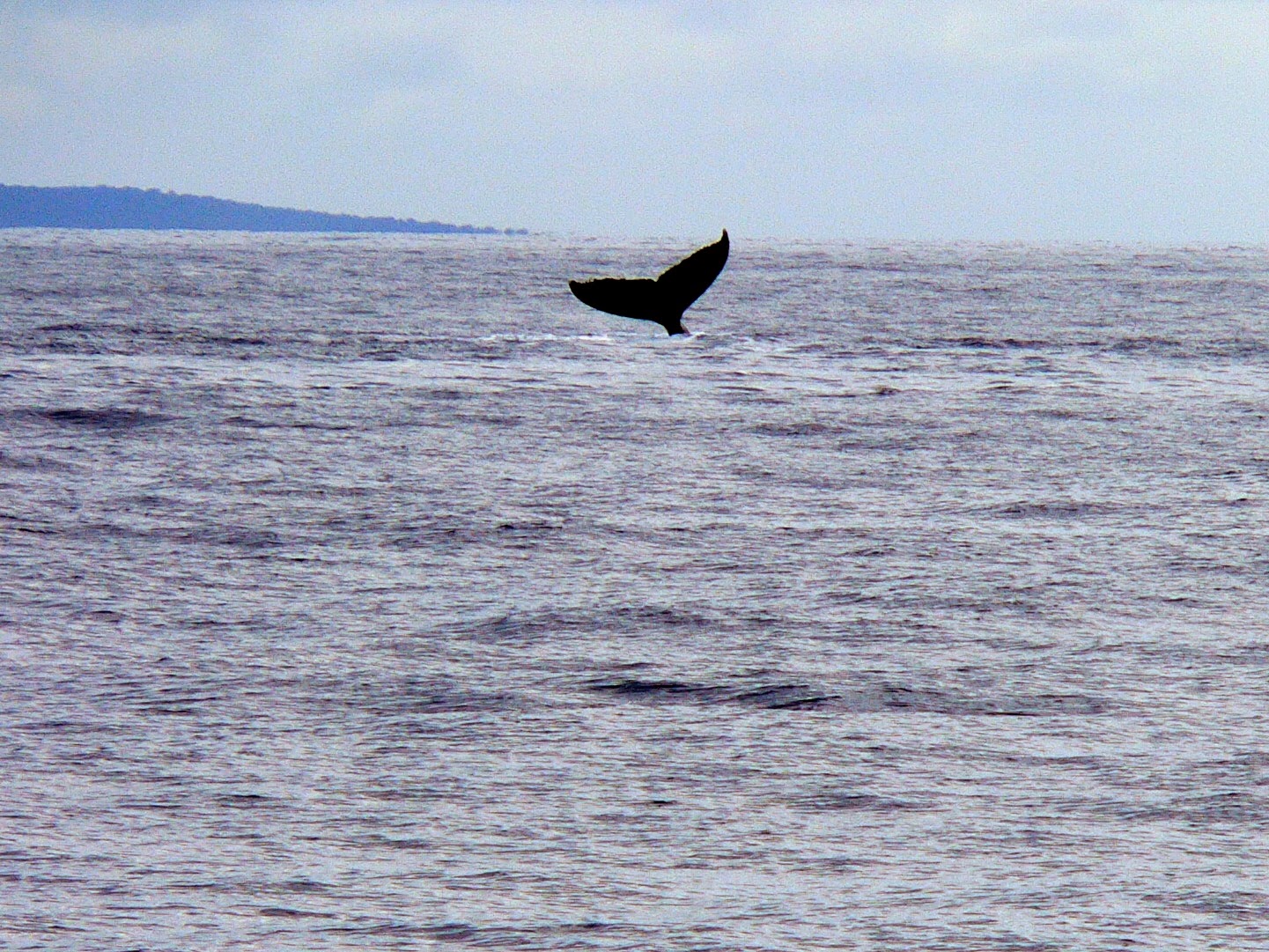
Whale


As soon as we began we immediately saw whales playing all around, blowing water out their spout, and showing off their jumping and splashing capabilities.  


Spinner Dolphins

The boat captain found a spot with dolphins.  We saw a large group of spinner dolphins - there must have been 30 or 40 of them playing in the sea.  I have never heard of them, but they like to jump straight up out of the water and spin around.  They swam along the side of the boat and in front of the bow - diving in and out of the water.  The fascinating site was seeing the dolphins swim on their backs since they had very light colored bellies.  It was amazing to see the various colors.  


We got our fill of whale sightings and certainly got our money’s worth.  We took over 200 pictures of whales and dolphins trying to capture the action of the great animals.


After the tour we spent some time checking out the local shops.  We got a bite to eat at a local diner and then found some great macadamia nut ice cream!  


Amy on the Waterfront in Lahaina


Later that afternoon it started to rain which is common on the island in the winter.  We saw several rainbows - there were double rainbows and in the mountains you could see a complete rainbow end-to-end.  It was a beautiful site.


Dinner was a nice relaxing meal at the Lahaina Fish Company overlooking the ocean.  Most of the restaurants were open air - the weather was just perfect night or day.  This was a nice relaxing dinner with a quiet romantic atmosphere.


Thursday started out with a traditional breakfast at another resort restaurant called Cast Away.  It was a small restaurant with a few more affordable options.  I had more local fruit and Amy got some pancakes.  Our plan was to take a ride on the Sugar Train.  It is a local train that runs 8-10 miles with three stops.  After sharing our plans with the hostess - she said we should save our money and take a drive along the west side of the island.  She gave us a map, pointed out a few key stops, and we were off!


 So we headed out in the jeep and took the top off.  We had to be back for our reservation at 5:00, so we have plenty of time to just drive.  The drive was simply amazing - we went through Kaanapali and then Kapalua.  The drive was on a small, windy road with lots of scenic stops.  We found one area filled with surfers trying to catch waves and other areas of beaches that were so remote no one was on them.


We discovered that we drove past the famous “blow hole” in Kapalua so we had to backtrack to find it.  The blow hole was a hole in the rock just off the beach.  As the waves came in, it created pressure along the rock and then the water blew straight up like a geyser.  We did not venture all the way down the hill to stand on the rock, but we did get some great pictures.


After that we got back on the road where the signs that say falling rock were - very true!  We saw rocks in the road that could have stopped a car in its tracks if you were not paying attention.  Construction crews were out removing the larger fallen rocks from the roads.  Many of the bridges were one lane and you had to be careful driving around the blind corners and tight turns.  As we made our way to Kahakuloa the roads narrowed down to one lane only.  


Kahakuloa from Above
We were told we had to stop by and see Aunt Lorraine.  This was a great suggestion.  She had an assortment of homemade pies, banana bread and handmade coconut chips.  We had some of the coconut pie and it was the best I had ever had.  Nice and cool with coconut chips in every bite.  We also had some of her famous banana bread and it was also very good.  

One of the cyclists we saw on the road had also stopped in to take a break.  He was a nice guy from Washington State who was also planning to make the whole trip around the same path we were on.


One lane roads......
With our fill of desserts we got back to the road, stopping at more scenic turnouts and taking more pictures.  We stopped at a local fruit stand and learned about the Mendoza family in Waihee - a very rich family who owned a large piece of property on that side of the island.  The proprietor of the fruit stand was making fresh coconut candy and I picked up some fresh cut papayas to take along the route. 

Civilization started to show back up as we ventured into Wailuku on the way to Kahului.  Fortunately the roads got better and wider.  We went on back to the airport and traded in the jeep for a silver convertible mustang.  The jeep had a funny smell from someone else leaving seashells in the car and the heat of the sun made the smell even worse!  The mustang was certainly a nice change given our next adventure.


We got back to the hotel and cleaned up for our dinner cruise.  The cruise was out of Lahaina and it began with a peaceful ride along the shoreline.  


Dinner Sunset View

The sunset was beautiful as it started to hide behind the other island.  We met Tom and Laura from Houston; they were recently married and he owned a house on the island.  They had some great stories to share and they gave us some ideas for the next day’s trip.  Dinner was served as the sky turned dark.  


The boat turned around just in front of our hotel and the night started to turn cool and breezy on the boat. The ride back was filled with a one-man band singing classic songs for everyone to sing along with, or you could dance up on the bow of the boat. We headed back to the hotel, watched a movie and called it a day.


First Sunrise
Friday began with an early 5 am departure from the hotel heading up to Haleakala Summit.  It is not very far away but the drive is very slow.  Mount Haleakala is where the sun rises up through the clouds at 10,000 feet.  The temperature was about 40 degrees at that height.  The drive was along the side of the mountain with many tight turns and steep inclines.  It was dark, so we could not really see anything but the road ahead and the city lights far below us.


Second Sunrise
The sunrise was well worth the early morning drive.  We shared the view with about 100 other tourists.  The sunrise is different because we were above the clouds, so instead of the seeing the sunrise above the earth, it was a sunrise above the clouds.  We got a bonus because as the sun rose, it went back into the clouds and reappeared again as it rose above the second set of clouds.  They called this a double sunrise. 


The local park guide sang the morning praises as the sun began to rise.  This is a local tradition done to give thanks.  We did not opt to take the bikes down the mountain as many tourists do.  I hear it is a really fun excursion but we chose to take off to Hana.


As we headed down the mountain we decided to take the back way around the island to Hana.  It started out on Highway 31 towards the southern remote part of the island.  After the local winery there was nothing but ocean views on our right, mountains on the left, lots of cattle crossing guards and some very treacherous roads that need some attention. 

We saw a lot of "One Lane Bridge" signs

We needed the jeep!


The area was very isolated - there we very few homes and no businesses.  We only saw a handful of cars and a few farm trucks.  The roads progressively got worse and turned to dirt as you got farther and farther away from civilization. 

Black Beach


As we got close to Kipahulu civilization began to return.  We were at the end of the traditional “Road to Hana” so this is where our adventure began.  We made multiple stops as we saw lots of waterfalls, steep cliffs, and beautiful mountain views.  We saw the black beaches on the southern side of the island.  It is obvious why this area is so sparse.  There is not much to do but enjoy the drive and there weren’t any beaches.  We did see the red beaches just before Hana and some of the locals were out enjoying the day there.

Red Beach


Coconut Ice Cream Stand - all plant based!
We stopped in Hana, ate at the local restaurant and rested for a bit.  We got back on the road and saw more waterfalls and scenic stops.  We did stop at a few of the local shops and stands along the way.  The best stop was the coconut ice cream stand.  There we got a bowl of vegan coconut ice cream.  This was a delicious treat - it was served in a real coconut shell with a wooden spoon.


Conquering the Mountain.....well of, the rock!


The road to Hana also had many one lane bridges and blind turns.  You could tell when the locals were driving because they went very fast and had little time for us tourists blocking their way!


The weather started to turn to light rain so we limited our stops.  As we got closer to Kahului the sun came back out.  We stopped near Pauwela where we walked the beach and saw some surfers.  We got a little wet when an unexpected wave hit the rock and splashed up on the beach.  This was funny to the locals as they laughed with us. It was like the funny videos you see on TV where the tourist gets surprised by the unexpected waves coming in. 


We headed back to the hotel, grabbed some pizza, and watched a movie.  It was a long day so early bedtime was in order.


Saturday was a peaceful day back at Lahaina.  We started the day with a couple’s massage.  We visited more shops and that is where we found our matching outfits for the Luau that evening.  I know it is quirky to have matching outfits - but we loved it.  We went back to the hotel, cleaned up, got our matching outfits on and headed to the Old Lahaina Luau.  We weren’t sure if there was going to be a Luau though.  It rained hard for a few hours beforehand, but as the gates started to open - the rain moved on. We had a beautiful evening before us.


At the luau there was a pig in the ground cooking, coconut opening demonstrations, and fishing net lessons. The luau was a series of local dancing and stories.  The dancers were great and it was very educational to hear the old stories.  The food was good and there were plenty of desserts to eat.


Running Path 


Sunday started out with a nice eight mile run for me into town.  It was great running along the ocean trail and - because it was early - it was very quiet and peaceful.  


When I returned, we headed to town for a quick breakfast and then Mass at the downtown Maria Lanakila Catholic Church.  


The church had tall vaulted ceilings, their windows open and the priest even wore a Lei.  The church was beautifully filled with local artistry, statues and paintings


We then drove over to Kihei where there were lots of beach parks and shops.  We ended up stopping in Makena and eating at Cheese Burger in Paradise.  They had the “big game” on and we enjoyed the upbeat game atmosphere, although we soon lost interest in the game.  After the halftime show, we drove back towards the hotel - making several stops on the highway to view the active whales in the ocean.  We did stop at Leoda’s pie shop just before Lahaina and we had coconut pie and peanut butter chocolate pie.  Although I am not a big dessert fan anymore - these where simply irresistible delicacies!


Full breach whale splash

This was off Hwy 30


After we got back to the resort we headed down to the Jacuzzi.  Just one problem, ours was broken!  So we ventured over to the neighboring hotel to use theirs - we snuck in quietly and found it!  We met some folks from Denver and they were crying over the game.  We had some great laughs with them.  That evening we ate a light meal on the beach near the hotel.

Monday was our last day of the trip.  We decided to head to the beach in front of the resort.  We had yet to spend time on the beach just laying around and soaking up the sun.  I got brave and ventured i to the cold water.  If you have never been on a Pacific Ocean beach you are in for a huge shock.  The waves are very strong, nothing like the Gulf of Mexico.  The waves can knock you over in an instant, and the currents can cause you to quickly lose your footing. 
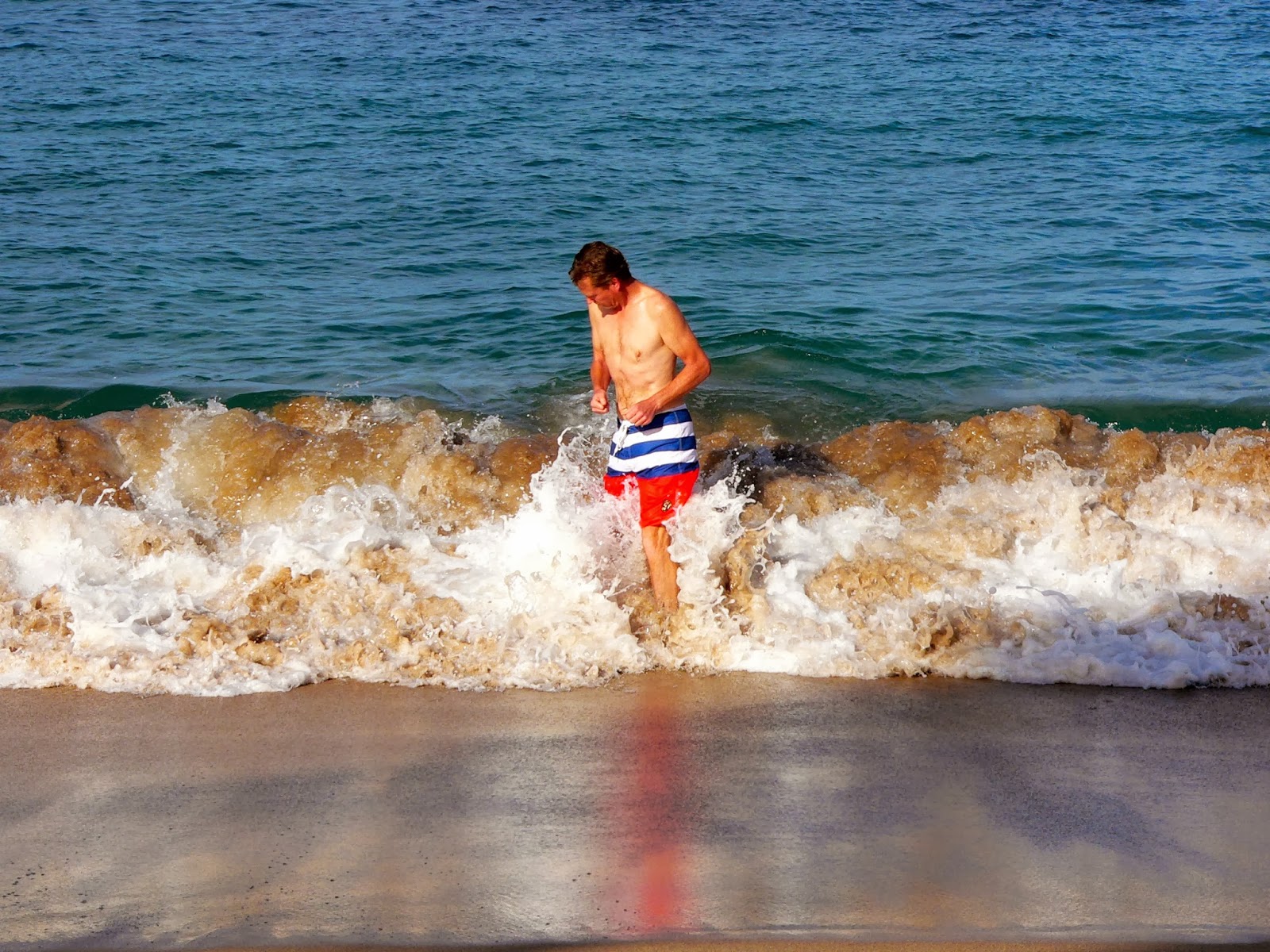

Braving the waters....


Looking for shells was a challenge.  You had to go waist-deep in the water to find them and then fight the waves as they try and pound you into the sand.  The waves won a few times, but I did find some great shells and coral fragments to bring home. 


We cleaned up and packed our bags, then headed back to Lahaina for lunch.  Before we left we bought a few photographs from a local photographer on the beach.  He had some great photos for us to hang on the walls at the house to remind us of the great memories made on the island.  In Lahaina, we stopped and had some deep dish pizza at Lahaina pizza.   We also met an old friend of mine from our hometown of Jacksonville, TX.  I had not seen Kathy in over 28 years, but it was just like old times.  We left Lahaina and slowly made our way back to the airport making a few last minute stops along the way.

Last Night at Hotel

The airport was bustling as the last few flights were leaving the island.  It was a long flight back and the plane was not very sleep-friendly, but none of that mattered because we had the trip of a lifetime!

Friday, January 24, 2014

Benefits Of Strength Training For Runners - Guest Post by Anja Koschak


Benefits Of Strength Training For Runners

Every runner-no matter if professional or recreational- is always interested in running faster, longer and stronger, but the way to get there is not by simply increasing the distance of your runs (which is a misconception many endurance athletes hold).

If you want to become a more efficient, more successful runner it will certainly work in your favor to incorporate strength training into your weekly workout regimen. Before you jump at my throat with complaints that you are not looking to get “buff”, please settle down and let me assure you that you will not become the next Mr. or Mrs. Universe due to incorporating strength training to your endurance training. What will happen, though, is that you become a more complete, a more well-rounded athlete with far fewer chances of getting injured. Sounds good? Well, lets get into the benefits of strength training for runners in a little more detail, so you will no longer be afraid of the weight room after reading this article.

 1)    Increase in Speed

Although this might sound counter-intuitive it has been proven over and over again that strength training will make you faster due to increased leg strength and better use of energy and oxygen during your runs.

A study proved when put in different groups (1. just running, 2. just strength training, 3. running and strength training combined and 4. a control group), male sports students who combined running and endurance training improved their performance in a 4k time trial by 8.6% and increased their V’O2 max by 10.4%.

The best kind of strength training to increase your running speed is heavy lifting targeting your lower body. Make sure you consult with a personal trainer or a savvy coach before you start a heavy lifting regimen! Good form is KEY.

 
2)    Body Fat Reduction

In order to become the best, most efficient runner you can be, your body composition should be large percentage of lean muscle mass vs. low body fat. Contrary to popular belief, (moderate) running alone (or any sort of endurance training for that matter) does NOT help you decrease body fat – unless you are running frequently at very high intensity. If that is not you, you need to start strength training in order to build lean muscle and decrease body fat.

3)    Injury Prevention

We all want to feel our best when we run and the last thing you want to happen is to sustain an injury that could side-line you for unknown amounts of time. Many runners suffer from muscle imbalances, joint discomfort, muscle weaknesses or even chronic pain, which all pose a hindrance in the enjoyability and efficiency of their runs. Sounds like something you are experiencing? If so, strength training will help you balance out your muscles, increase your joint stability and help you build a better base for your body, which means that you will be protected from getting injured all too easily.

4)    Better running economy

A study proved that maximal strength training improves running economy. Well-trained runners were divided into an intervention group and a control group. The intervention group performed half-squats 3x a week for 8 weeks in addition to their regular endurance training regimen. The control group continued their usual endurance training throughout said time frame. Results show that the strength training group was able to increase their time to exhaustion at Maximal Aerobic Speed by 21.3%! Note that body weight stayed the same in both groups (no bulking up for you!).

5)    Better Recovery

Strength training will improve your insulin sensitivity, which is extremely important in order to speed up your metabolism and increase your energy levels as well as prevent you from developing diabetes. (Insulin sensitivity is the relationship between how much insulin needs to be produced in order to deposit a certain amount of glucose.) Due to better metabolism and increased energy levels, your recovery from long runs will be much easier because your body will be able to convert metabolic waste into energy.

Now that we have covered some important aspects of why it is essential for any type of runner (long distance, ultra distance, short distance) to incorporate strength training to their workouts, you might be concerned with time management and how to fit in strength training on top of your running workload. I get it. Chances are, you have a job, you have a family, you already spend a good amount of hours running and the thought of having to fit in weight training at the gym seems daunting if not impossible.
 
Do not panic! Here is the great news: Experts have agreed that not a lot of time in the gym is required in order to see significant results for your running performance. The common census is that just 30 minutes of 8-12 exercises 2-3 times a week will yield great improvement for your running efforts. While lifting heavier weights will increase your strength and in consequence make you faster, some runners prefer to keep their strength training to all calisthenics (body weight exercises), which in most cases also helps you avoid muscle imbalances and maintain good form during your runs.

Either way you look at it, you cannot deny the great benefits of strength training for endurance athletes- especially runners. I sincerely hope you will make the adjustments needed in order to fit in some strength training in addition to your runs. Be better, be faster, be stronger and always ENJOY the journey!


About the author:

Anja Koschak is a personal trainer and health coach in New York City. 

For her full bio, her blog, exercise videos, pictures and contact visit her website www.allupanja.com


Thursday, January 16, 2014

Running Shoes, Here are my thoughts……

I am asked all the time about running shoes.  As a long distance runner, it would seem reasonable to think I have this topic down pat.  The fact is I don’t.  Then why would I write a blog?  Well, I feel that I do have some decent guidelines to share, and some do’s and don’ts that can help other runners choose the best shoe for them.  There is no exact shoe science, everyone has an opinion.  The bottom line is you have to find what works for you.  It can be a “trial and error” effort and can cost a few extra dollars if you miss the mark and end up buying another pair of shoes.

How I pick shoes: The very first pair of running shoes I ever bought in the early 90s were Asics Gels.  They were a basic, mid-priced running shoe and I think back then they were the GT series.  When I started running again 2 ½ years ago, I went back to what had worked before.  I picked up another pair of the Asics in the same family and I was off and running!  Up to this point, all was going well.
As I started running and increasing mileage, things went pretty well for me.  I did not have any major issues and no additional injuries after I recovered from a slight case of planter fasciitis right when I started running again.  Keep in mind I was very heavy then and attribute the injury to being out of shape and overweight.

Over a year ago, I read “Born to Run.”  This is an excellent book about the history of running and a considerable amount of time is spent on running shoes and the history behind them.  There is also a lot of information about natural running in the book (runners who wear no shoes or minimal shoes).  This made me wonder if this approach would work for me!  I recently read “Tread Lightly.”  This is a detailed book about running form and shoes and, while they had a lot of information, they did not have any specific conclusions either.
The first change I made in my personal running was to focus more on “mid-foot striking.”  This is where you transition from landing on the heel to more of the middle or front of the foot.  I have always been a heel striker and who wouldn’t be if you had a big cushioned sole to land on, right?  As I made this change, I quickly realized that the shoes I wore actually made it hard for me to run the way I wanted to.  So off I went to the running store and started asking about lower-heeled shoes. 

I was currently in a 13 mm drop shoe (heel height compared to toe height) and wanted to get to a 4 to 6 mm drop.  I ended up buying the Brooks Pure Flow II.  They felt good and accommodated my wide toes.  These shoes have worked well for me and I run more and more forefoot these days.  The other change that has recently occurred is my foot has gotten wider - I now wear a ½ size larger running shoe.  This is a result of running more mid-to-forefoot and spending more time barefoot.  I made a conscious decision to go barefoot around the house and wear five-finger shoes when I walk.  Our feet were not designed to be cooped up in shoes.  Shoes actually prevent our feet from being as wide as they might normally be.  For the fashion conscious, this is a disaster BUT we need to take care of our feet.  Walking barefoot also helps to build up the foot’s own natural ability to support our bodies without relying on shoes to make our feet weaker.
Here is what you have to look for in shoes.  First, the store clerks may not be your friend!  They are typically trained by the shoe companies to focus on the latest features, current lingo and using the approach that “more expensive” is better.  This simply is not true in most cases.  You can find very reasonable priced shoes to accommodate your running needs.  Heck, I look for last year’s models and save 30-50%!  How much can technology change in one year to magically fix all that ails us?

For you fashion-minded runners do not get caught up in the look or color of the shoe.  Focus on fit and function - not razzle and dazzle!  Most shoes offer color choices, although you may have to order the color you want.
I suggest you seek out a shoe store with real runners working there; at least they have personal experience.  Second, go to several specialty stores. Big box retailers are fine if you know what you want, but they are horrible places to get advice and recommendations.  Ask around, try various shoes on and go for a quick jog in the store!  Many of the good running stores will let you run in the shoes for a short period of time and still exchange them.  Having salespeople tell you that you need to fix your own natural running form can be a stretch!  You certainly can change your running form and make corrections, but you are who you are.  So what if you pronate, 80-90% of us do.  It does not mean we need to overcorrect it and cause our feet not to naturally land and then push back off. 

A running analysis in a shoe store may also be counterproductive.  How can one person tell how well the shoes fit by watching you run for 5 to 10 seconds in the store?  The naked eye is not that perceptive.  Video analysis is much better if you are not running in your normal environment.  Would you want to buy shoes while running on a treadmill while 90% of your runs are on pavement? 
If you can get away with less shoe and still run comfortably, then this may be your best approach.  Buying big bulky over cushioned shoes prevent our foot’s own natural ability to support our bodies.

Shoe Mileage – you will hear a lot about how many miles you can run in a pair of shoes.  The typical manufacturer says 300 to 500 miles.  So how do they know this?  Your own style of running will determine this.  The type of runner you are, your weight, and the surfaces you run on, etc.   I usually get twice the distance out of my running shoes.
You should also consider having multiple pairs of running shoes.  I typically use two of the same pair and rotate them.  As the shoes age, I use them more for shorter runs and the newer shoes for longer runs (after they have been broken in).

I have other long distance runners tell me they like a variety of shoes. Their thought is - why run in the exact same pair?  Change it up so your feet are more adapted.  I see their point and have no issues with it; however, for me personally I run in the same environment week after week, typically paved trails and roads, so I want the consistency.  Obviously if you run on a track, do trail runs, or run on dirt, then this will lend itself to having to stock up on a wider variety of shoe types.
I find that brand matters as it relates to the shoe fitting your foot.  For example, I love Nike shoes, but I cannot run in them because they tend to be narrower.  You may find that certain brands will fit your feet better and you can then narrow down the choices among those brands.

You want to be sure and get the right size shoe.  Most brands of shoes will require that you buy a ½ to a full size larger.  You want at least the width of your thumb between your longest toe and the end of the shoe.  Trust me - this is important!  Your feet will swell while running and the extra room is needed as you run because of the contact flexing of the foot.  If you have issues with blisters or bruised toenails, it may be time to size up or change shoes.
If you decide minimalist running is for you - be cautious in your approach.  You never want to make drastic changes in shoes or running style, especially if you are in the middle of your training season.  Going from a full-sized heel to a minimal shoe can be a shock to the body and your legs.  Slowly transition to a minimal approach.  If you run 20-30 miles a week, you may only get 2-3 miles in a minimal shoe the first week.  Yes, it is that drastic because you are running on your foot in a different way and you need to give your feet and legs time to adjust and grow stronger.  In a full-cushioned shoe your feet are more relaxed and do not have to work as hard.  However, making this change can have a positive impact on your runs after you make the adjustments.

I doubt I will ever be a full-blown minimalist shoe runner, but I do want to continue to reduce the dependence on the shoe and strengthen my feet to provide the support they were designed to give me and my body.


Friday, January 3, 2014

How I Ran Back to Back Marthons in 2 Days! #NewYear52point4


Here is an overview of my 2013/2014 New Year’s Double Marathon experience!
 
Allen Double Marathon Results:

Day 1: 4:25

Day 2: 4:44

Total: 9:09 for 52.4 Miles

Statistics: finished in the top 50% for all statistical categories!

Day 1:

Day 1 was pretty simple and routine for me - two cups of coffee with coconut crème and a banana.  During the race, I had a banana and two salt sticks at mile 13, and the same at mile 19 ½.  The race was four out-and-back loops.  While my fastest marathon is a 4:09, I was not planning on “racing” - just keeping the pace strong.  The goal was to finish under 4:30 and feel strong the next day!  The only challenge I had was around mile 21/22; my stomach felt stiff, not like a cramp, but more like bloating.  I wondered if the 2nd banana was too much.  I finished strong, never stopped and had plenty of energy. 

That afternoon I had a “fat” green smoothie (spinach, large avocado, chia seeds, coconut milk and berries blended up in a Vitamix®) and Mexican food for dinner with plenty of grilled veggies.  While I was certainly sore, I would say I felt pretty good overall.

Day 2:

Day 2 was about the same, except I ate the banana closer to race time (I felt a little hungry at mile 8 the day before).  I also had an almond nut butter packet and added extra coconut oil to my coffee so I could top off the fat stores.  During the race I stayed on plan - one banana at mile 13 with two salt sticks.  At mile 19½ I decided to skip the banana, had the salt sticks and grabbed a Honey Stinger instead.  I took in tiny amounts of the Honey Stinger (sugar trickling) every few miles and finished it off at mile 24. 

I felt strong on day 2 up until mile 21 - then I had to run/walk for a few miles.  It wasn’t whether I would finish, but it was more about how long I wanted it to take!  Due to the lack of training for this type of event, I just did not have as strong of a foundation as I would have liked to have had.  I was able to run the last mile all the way in!  While the 4:44 time was not a record (my goal was a sub-5 hour for day 2), it was faster than my first marathon, so I felt pretty good about it not being my slowest race.

Summary:

In summary, the race went as planned.  I did not plan on running two marathons back-to-back until Dallas cancelled their race in December.  I only had a few weeks to turn my marathon training into double marathon race training.  I am still amazed that I ran both races on three bananas and one Honey Stinger!  Talk about fat-adapted training really working!

Next up is my first 50K Ultra in February.  I think I will play around with Generation UCAN on my next few long runs - I believe it may help spread out the nutrition a little better.

Lessons Learned:

Music mattered on day 2!  By this - I mean I was pickier about the songs that played on my iPhone when it got tough.  Having a support crew would have helped as well as I ran the race both days by myself.  Next time, I will pay one of my kids to be there and to drive me home!!! 

Finally, if you train properly and build a solid training base, you can achieve more than you realize.  Training fat-adapted and building up a strong Zone 2 base will go far and help reduce the risk of injury.  I did get ill for a few days in mid-December; this reminded me that I was not immune to overtraining and needed to back off a bit after the San Antonio Marathon I ran in November.

While I did not have a strict race plan, I did set realistic goals and expectations.  The challenge when charting new ground is to keep it simple and have fun.  Running a few back-to-back days helped before the race and I wish I’d had more time to incorporate that into my training.  I hardly ever run multiple days in a row. 

Why I decided to run this race:

I wanted to qualify for Marathon Maniac (MM) status (three marathons in 90 days)!  In June, I realized I needed to add a 3rd marathon to my race schedule to qualify.  My 50K Ultra was beyond the 90-day window of the first race in San Antonio.  About mid-November, I saw the hardware they were giving away for doing a race on both days so I added the half marathon to my schedule.  Then, after Dallas cancelled due to the ice storm, I was in a bind.  I had already run one marathon and had the ultra two months out, so the best way to accomplish this was to run two full marathons back-to-back!  The upside is - this qualified me for the Iridium level of MM and I got some pretty cool hardware to go with it.

You can read more about Plant Powered No Sugar No Grains fueling (PPNSNG), Zone 2/fat-adapted training, and marathon training on my other blog entries:


http://bjtucker05.blogspot.com/2013/09/how-to-train-for-marathon.html


 Day 1 & Day 2 Photos:


Tuesday, December 24, 2013

My Story and how I regained my own health!


My Story and how I regained my own health!

Before & After:


I am 44 years old, a father of five wonderful children and I have been married for almost 28 years.  Like many others, my story is about a guy who went from a somewhat healthy 25 year old to being a 75 lb overweight old guy at 43, unable to keep up with my kids and finding it very difficult to keep up with life.

About 2 ½ years ago I decided that I needed to change.  Nothing magical happened; I just decided I was tired of being tired.  I started with small incremental changes - eating healthier, natural foods and jogging/walking.  Right away I started to see positive results.  I did not follow any diets or take any magic pills!  As I made small changes and saw positive results, it motivated me to do more!  I also started reading books, listening to audio books, and following endurance athletes.  After a year I was down 65 lbs.

Fast forward another year, I ran my first marathon (Dec 2012) and it felt great!  I was so overwhelmed by my results that I decided to step up my game because it really was not that hard.  Looking back, I know a lot changed, but because it was small changes over time it never seemed like a big deal!

Now I have run three marathons, I have lost additional weight, and I am leaner that I have ever been.  I have not had any injuries and my energy is through the roof!  I have two more marathons to complete and my first ultra this season. 

The key is to decide to make changes!  The other challenge is many people fall into the trap of quick fixes.  There are no quick fixes - it takes work, it takes time, and you have to be committed!  Most people fail because the motivation to do something wears off shortly after a decision is made to change.  You have to view this as a lifestyle change.  If you make changes to reach some weight goal and then go back to the same old habits then you have gained - or in this case lost - nothing long term.

Now what are the specifics of my changes?  First, just because I run does not mean it made me skinny!  The fact is the dietary changes allowed me to run faster and farther while remaining injury-free.  You must change dietary behaviors! 

I am plant powered, which means I eat very little animal products and I do not consume any meat.  I gave up alcohol.  I found this to be critical for me because alcohol was preventing some of my weight loss and it caused me to not stick to my plan while I was drinking.  I focus on eating real whole foods, I limit my sugar and grains, and I eat a ton of fruits and veggies! 

I do not believe you need to eat meat to be healthy; however, if you do eat meat or dairy, you can be healthy, but you must be aware of the dangers.  It is very difficult to find clean natural sources of animal products, just be aware.

As a result of my experience, I now work to help others with their fitness journey.  I am not a certified “anything” nor do I have any credentials outside of my own experience.  In fact, many people have been misled by the industry giants, whether it is with food, health or fitness.  Be sure to use your own judgment when making changes or pursuing future goals.  There is a lot of bad information out there and it can be overwhelming.  I have set up a few resources if you want to follow me or see more details.

Good luck and I would love to hear from you!

Originally posted at:
http://www.allupanja.com/my-story-and-how-i-regained-my-health-guest-blog-post/


Wednesday, December 18, 2013

10 Steps To Mastering A Plant Based Diet - Ben Greenfield guest post!


10 Steps To Mastering A Plant Based Diet

It’s a common question. Can we get by eating plants as a sole source of fuel?

As we swim and thrash through ocean chop, hammer bike cranks for hours on end, repeatedly pound on pavement, and hoist weights at the gym, do we actually need the animal-based foods to maintain and restore our precious nutrients – or can we get all our performance and recovery needs from plants alone?

In a blog article on my site entitled “How To Be Extremely Active And Eat A Plant-Based Diet Without Destroying Your Body”, I dig into the omnivore vs. herbivore debate, lay out the argument of both sides and reveal the diet regimen of a variety of plant-based athletes from ultraman Rich Roll to aging endurance athlete Dr. Bill Misner.

But the purpose of this article is not to argue for or against a plant-based diet, but to instead to give you 10 ways to master a plant-based diet in a way that ensures you ensure that you avoid body and brain damage, especially if you want to combine a plant-based diet with high amounts of physical activity.

After all – it can be incredibly simple to eat a plant-based diet in a manner that leaves gaping nutritional holes, such as not eating a wide variety of colors in whole plant food, not eating enough calories, and not supplementing with vitamins, fatty acids, amino acids, minerals or micronutrients that are notoriously missing from a plant-based diet.

Technically, on a plant-based diet, you can also gorge on soy ice cream, licorice, Twinkies, Taco Bell salads, and Domino’s Pizza all day long and call yourself a vegetarian.  You can stuff your face with chemical-laden, processed meals like fast food french fries, potato chips, and “fake meat” products like veggie sausages, bacon & burgers all day long, and still technically call yourself a vegan.

So here are my top 10 strategies you need to include if you decide to go plant-based:

  1. Eat real food. Avoid plant-based Frankenfoods such as fake meats, textured vegetable proteins and processed soy products. Soy is a biggie. Soy contains digestive irritants and digestive enzyme inhibitors such as lectins, phytates and protease inhibitors. Granted, most of these compounds can be rendered relatively harmless through fermenting soy and consuming it in forms such as miso, natto and tempeh – but you should avoid popular unfermented, processed foods such as soy milk and tofu. Soy also contains high levels of goitrogens, which are compounds that inhibit the thyroid’s ability to utilize iodine correctly. This could lead to hypothyroid problems if you have a high soy consumption. Finally, soy contains plant estrogens in the form of isoflavones which can raise your estrogen levels and lower your testosterone levels. So women with estrogen dominance or men and women with testosterone deficiencies shouldn’t be including soy in their diet.
  2. Avoid high intake of inflammatory omega-6 vegetable oils such as soybean oil, corn oil, cottonseed oil, sunflower oil, peanut oil, or margarine. Instead, use coconut oil, olive oil, avocado oil or macadamia nut oil. At the same time, increase omega-3 fatty acid intake from readily absorbable algae-based DHA supplements such as spirulina and chlorella and get some omega-3 based ALA from things like ground chia seeds, hemp seeds, or flax seeds.
  3. Supplement with vitamin K2. Vitamin K2 is critical for a healthy heart and skeletal system and is notoriously deficient in a plant-based diet. I highly recommend a vitamin K2 supplement, consumed at about 100mcg per day, along with generous amounts of natto (which incidentally goes well with avocado, sea salt and extra virgin olive oil for a nice breakfast). Natto is very easy to make once you get a starter batch from your local Asian grocery store.
  4. Supplement with Vitamin D3. If you want to keep your bones and teeth strong, and give yourself adequate hormone and steroid precursors, I recommend about 35IU of Vitamin D3 per pound of body weight. This could be tough if you’re a strict vegan, because most supplemental vitamin D3 is derived from wool, and most vegan versions contain vitamin D2, which is a far less potent form. Garden of Life Vitamin D3 is one of the few vegan D3 brands out there. If you’re eating this much Vitamin D3 you must avoid toxicity by ensuring you balance the Vitamin D with intake of both Vitamin K and Vitamin A. Otherwise, it can do more damage than good.
  5. Get Vitamin A. Vitamin A is crucial for healthy bone tissue, vision and hormones, but plants only contain beta-carotene, which your body converts into vitamin A, but at a very inefficient rate. You need to focus on enhancing this absorption as much as possible by eating beta-carotene rich foods with fatty meals (i.e. have your beta-carotene rich foods with olive oil or avocado), and getting adequate iron and zinc, which help you convert beta-carotene into Vitamin A. Cooking beta-carotene rich foods also helps to increase absorption. Beta-carotene can be found in concentrated amounts in a variety of foods including sweet potatoes, carrots, kale, spinach, turnip greens, winter squash, collard greens, cilantro, fresh thyme, cantaloupe, romaine lettuce and broccoli.
  6. Properly prepare grains, legumes, or nuts. As you learned in point #1, fermentation can render soy more digestible. Similarly, you can neutralize many of the anti-nutrients and mineral binding compounds in grains, legumes and nuts by learning how to properly soak and (if desired) sprout and ferment them. Here is a useful soak time chart for most grains, legumes and nuts. The bigger the legume, nut or grain, the longer soak time it typically needs.
  7. Maximize iron absorption. Non-heme iron is the form found in plant foods, and it’s less bioavailable than the heme iron in meat. But you can increase iron absorption from plant-based foods when you consume them in the presence of Vitamin C (similar to consuming beta-carotene rich foods with oily foods). Combining foods such as swiss chard, spinach, beet greens, lentils, beans, and quinoa with  foods high in Vitamin C like tomatoes, bell peppers, lemon juice, strawberries, oranges, papaya, kiwis, pineapple, or grapefruit. You should also moderate tea or coffee consumption, since these both reduce iron absorption.
  8. Use iodine. Plant-based diets are notoriously iodine deficient. Sea vegetables such as nori, kelp and dulse are the best natural, plant-based sources of iodine. At the website Main Coast Sea Vegetables, you can find many iodine sources that you can easily read about or order. Also consider taking supplemental iodine in a form that is readily used by your thyroid, such as a daily dose of liquid nascent iodine, at about 6mg per day.
  9. Take vitamin B12. Nearly every study conducted on vegans show much higher rates of B12 deficiency than omnivores, with elevated homocysteine as a result (homocysteine increases blood clotting and raises your risk of heart disease). So I recommend that if you’re eating a plant-based diet, you consume a highly absorbable liposomal Vitamin B12, at about 10mcg per day.
  10. Supplement with taurine. Taurine is an amino acid found only in animal foods, and it is crucial for brain development, healthy blood pressure, blood glucose stability, fighting free radicals and protecting your vision. Your body can make it’s own taurine from a combination of other amino acids, but as you can read in this study, this can be very hard for vegan athletes to pull off in adequate volume. There are vegan taurine sources out there such as NOW Foods Vegan Taurine Powder (a much healthier alternative to Red Bull), and I recommend using 1 gram per day.
My personal diet includes many, many plants – topped with a high amount of natural fats such as avocadoes, olives, olive oil, nuts and seeds. While I also eat animal-based foods, I would instantly implement every step above were I to ever switch to a plant-based diet and want to ensure my body recovered as quickly as possible and was ideally optimized for workout. If you have questions, comments or feedback, I’ll be happy to reply!

Author Ben Greenfield is currently writing a book about how to be healthy on the outside and healthy on the inside. You can learn more at BeyondTrainingBook.com.


Who is Ben Greenfield?


Ben Greenfield is a coach, author, speaker, ex-bodybuilder and Ironman triathlete. His science-based approach to discovering a potent balance between health and performance has revolutionized the way thousands of athletes and exercise enthusiasts around the world live, train and eat. Ben now works with athletes, CEO’s and soccer moms from around the world to achieve amazing feats of physical endurance without destroying their body in the process.

In 2008, Ben was voted by the National Strength and Conditioning Association as the America’s top personal trainer. He holds a Master’s degree in exercise physiology and biomechanics from University of Idaho, and is also a certified sports nutritionist (C-ISSN) and strength and conditioning coach (CSCS). He has over a decade of experience training professional, collegiate and recreational athletes from all sports how to be healthy on the inside and healthy on the outside – and also coaches people of all ages and from all backgrounds for performance, fat loss, nutrition, lifestyle management and wellness.

In addition to being the head coach and nutritionist for Pacific Elite Fitness and the Rock Star Triathlete Academy, Ben is a consultant for WellnessFX, host of the Get-Fit Guy and BenGreenfieldFitness.com podcasts on iTunes, author of over a dozen programs and books for optimizing health and performance, and owner of EndurancePlanet.com, the world’s top endurance sports entertainment website. Ben also trains and mentors physicians, personal trainers and physical therapists from around the globe via his mastermind Superhuman Coach Network at SuperhumanCoach.com.

If you’d like to learn more about Ben visit this page. He consults virtually and in-person with people from all over the world via his office in Spokane, Washington, where he lives with his wife and twin boys, and now travels around the world competing in triathlons and teaching advanced human performance and nutrition concepts.


Read more:
http://www.bengreenfieldfitness.com/start-here/#ixzz2nf284B6m